
Read time:
Don’t let the wrong pump drown your project. Here is Wenbro’s definitive guide to choosing the right Pump for the job.
Rain isn’t the only way a site floods. Hit the water table, strike a water pipe or buried main, or lose power to a dewatering pump, and you could suddenly be dealing with thousands of litres of water across your site. Regardless of how it got there, water can cause damage and interrupt your project, often causing unforeseen delays when you’re under pressure to meet tight deadlines. This can mean flooding on site, excavations or trenches filling with water, inaccessible underground service lines, unstable soils, silty run-off or even a burst water pipe in your garden or business premises.
1. Centrifugal Petrol & Diesel Pumps — The Everyday Workhorse
Centrifugal pumps are the backbone when it comes to transferring water and dewatering, where the water is relatively clean. When most people think of a “pump,” they are picturing these standard centrifugal surface pumps. These Pumps create a vacuum that allows atmospheric pressure to pull water up through a suction hose (intake) and “push” it out the discharge side (outlet). This efficient design makes them the go-to choice for moving water from a dam or bore, directing it into piping systems for storage or irrigation. They are also widely used to draw water from domestic wells.
The size of the intake and outlet defines the size of the Pump; for example, a 2-inch pump will have an outlet diameter of 2 inches. Centrifugal Pumps require a little prep to “prime” before they get to work. You must manually add water to the pump housing before starting the engine; this ensures the impeller has the liquid it needs to create the necessary vacuum for operation. Skipping this step can lead to a dry run, which can easily lead to damaged seals and costly downtime.
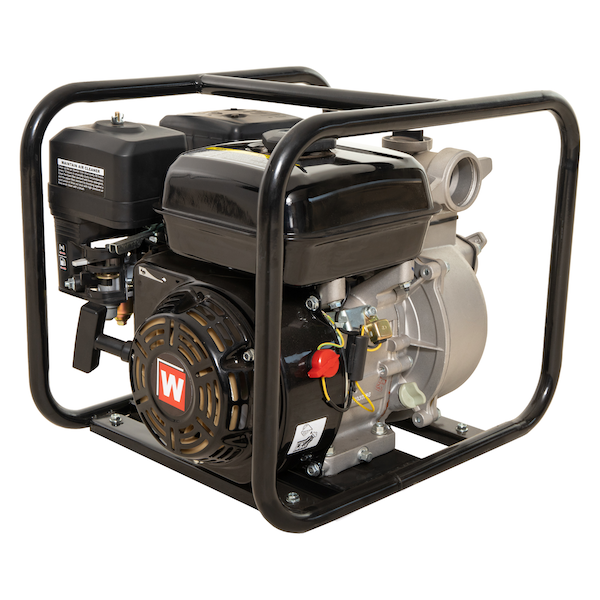
2″ Centrifugal Water Pump 6hp (Petrol)
Tech Specs
Engine: 6hp Wenbro Engine
Fuel Type: Petrol
Start Type: Recoil/ Pull Start
Fuel Tank Capacity (Litres): 3 L
Outlet Size: 2″ / 50 mm
Head (Metres): 33 m
Water Displacement (Litres Per Minute): 600 L / Minute
Weight: 25.5 kg
Sound Output (dB): 91 dB
The 2-inch Petrol Centrifugal Water Pump is ideal for small-scale irrigation, smaller excavations, general site drainage or clearing pooling water where space is limited. Some examples include foundation prep (to quickly clear out rainwater from footings or trenches before a concrete pour) and residential utility (a great choice for draining swimming pools or small garden ponds for maintenance or repairs). Its light weight means one operator can move it across a site without hassle.
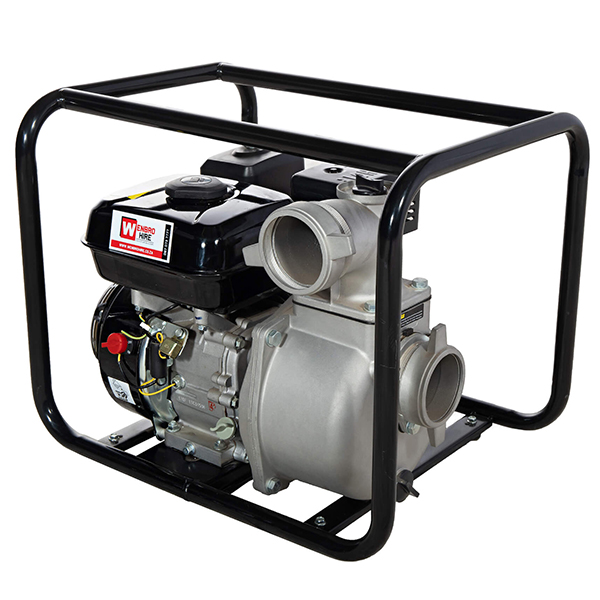
3″ Centrifugal Water Pump 6hp (Petrol)
Tech Specs
Engine: 6hp Wenbro Engine
Fuel Type: Petrol
Start Type: Recoil/ Pull Start
Fuel Tank Capacity (Litres): 3 L
Outlet Size: 3″ / 75 mm
Head (Metres): 33 m
Water Displacement (Litres Per Minute): 900 L / Minute
Weight: 29.5 kg
Sound Output (dB): 91 dB
This 3-inch Petrol Centrifugal Water Pump is often the go-to choice for Contractors. It balances portability and output, moving substantial volumes of water without requiring a team to move it around. Some uses include agricultural transfer (moving water from a dam or borehole into a localised irrigation tank) and medium-scale site drainage (for instance, clearing larger low-lying areas on a construction site after rain).
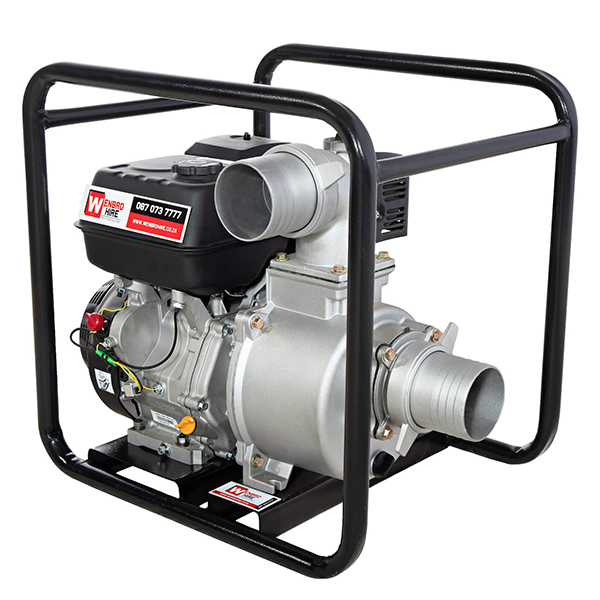
4″ Centrifugal Water Pump 6hp (Petrol)
Tech Specs
Engine: 6hp Wenbro Engine
Fuel Type: Petrol
Start Type: Recoil/ Pull Start
Fuel Tank Capacity (Litres): 3 L
Outlet Size: 4″ / 100 mm
Head (Metres): 30 m
Water Displacement (Litres Per Minute): 1 200 L / Minute
Weight: 54 kg
Sound Output (dB): 95 dB
When you need to drain or transfer large volumes of water, this 4-inch Petrol Centrifugal Water Pump is the unit you want running. Larger trenches, flooded groundworks, or situations where time pressure matters, this pump is for those who need serious water displacement. Great for emergency flood control (such as when a basement or underground parking lot is rapidly filling up with water) or reservoir management (for high-volume water transfer between large holding tanks or reservoirs).
The Diesel Factor
Diesel-powered Centrifugal Pumps are the preferred choice for long-term durability. Diesel engines are built for longer duty cycles (extended durations of continuous use). They offer improved fuel efficiency over extended periods and align well with sites that have their own Diesel stored on-site, or have mobile Diesel Bowsers. If your project requires a pump to run for extended durations, the Diesel option provides superior fuel economy and higher torque, ensuring the pump doesn’t skip a beat under constant load. Another benefit of Diesel fuel is that it’s much higher flashpoint (compared to petrol), so it’s much safer to store large quantities.
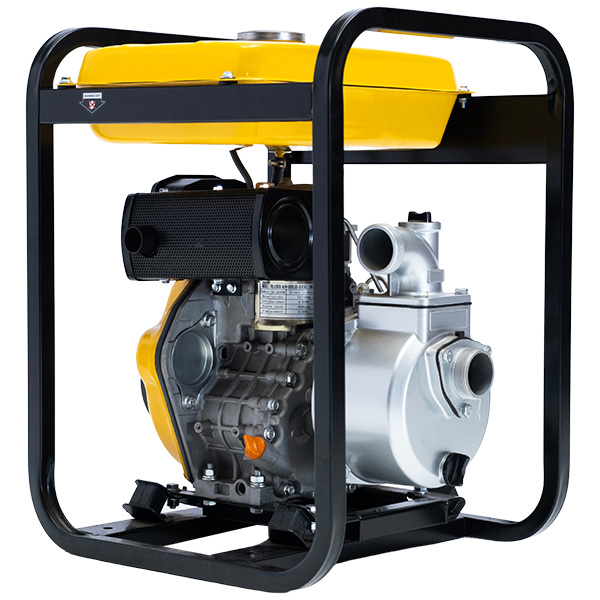
2″ Centrifugal Water Pump 4hp (Diesel)
Tech Specs
Engine: 4hp Wenbro Engine
Fuel Type: Diesel
Start Type: Recoil/ Pull Start
Fuel Tank Capacity (Litres): 2.5 L
Outlet Size: 2″ / 50mm
Head (Metres): 26 m
Water Displacement (Litres Per Minute): 700 L / Minute
Weight: 39 kg
Sound Output (dB): 91 dB
The 2-inch Diesel Centrifugal Water Pump is a high-torque, fuel-efficient workhorse designed for small-scale irrigation, foundation prep, and clearing pooling water in tight spaces. Its diesel engine provides the extended run times and lower operating costs necessary for demanding tasks like rapidly draining rainwater from footings before a concrete pour or maintaining residential ponds and swimming pools.
Engineered for durability and continuous use, this pump delivers reliable performance where petrol units are less suitable. Despite its rugged construction and Diesel engines being heavier than their petrol counterparts, the compact frame ensures it remains light enough for a single operator to manoeuvre across a job site without hassle, making it an ideal choice for efficient, long-duration drainage and water transfer.
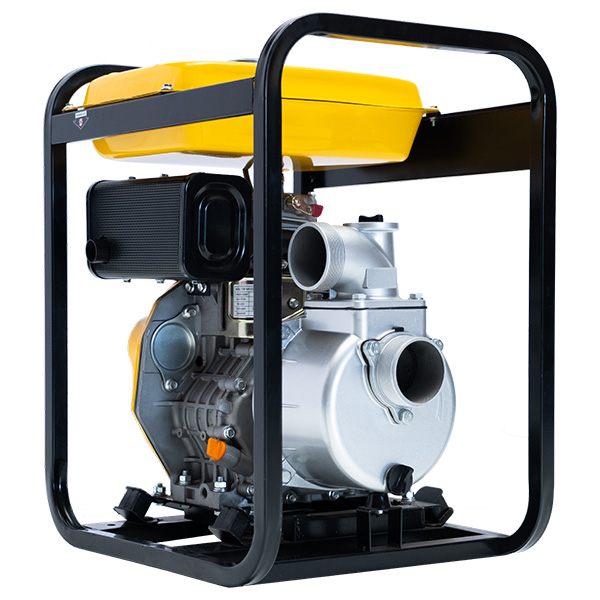
3″ Centrifugal Water Pump 4hp (Diesel)
Tech Specs
Engine: 4hp Wenbro Engine
Fuel Type: Diesel
Start Type: Recoil/ Pull Start
Fuel Tank Capacity (Litres): 3.5 L
Outlet Size: 3″ / 75 mm
Head (Metres): 28 m
Water Displacement (Litres Per Minute): 1 000 L / Minute
Weight: 46 kg
Sound Output (dB): 91 dB
This Diesel 3-inch Centrifugal Water Pump is the reliable backbone for heavy-duty use. It balances a high 1 000 L/min output with diesel endurance. It excels in roadwork drainage, transferring water between reservoirs and Water Bowsers on construction sites, and clearing large bodies of pooling water after storms. Beyond that, it is the perfect size for municipal teams managing temporary bypass pumping during water line repairs, or for quarry managers who need to continuously manage groundwater seepage at the bottom of a pit.
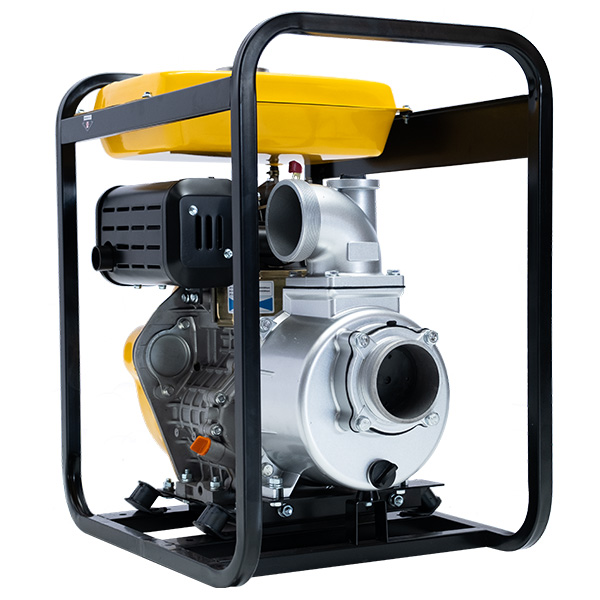
4″ Centrifugal Water Pump 4hp (Diesel)
Tech Specs
Engine: 4hp Wenbro Engine
Fuel Type: Diesel
Start Type: Recoil/ Pull Start
Fuel Tank Capacity (Litres): 3.5 L
Outlet Size: 3″ / 75 mm
Head (Metres): 28 m
Water Displacement (Litres Per Minute): 1 000 L / Minute
Weight: 46 kg
Sound Output (dB): 91 dB
When you need to move larger volumes of water reliably, this Diesel 4-inch Centrifugal Water Pump is your solution. For small-scale flood mitigation in low-lying civil projects and other high-volume industrial dewatering, you need a pump that can handle a respectable 1 600 litres per minute for extended durations. This is the go-to choice for commercial fish farm drainage, managing agricultural flooding after stormwater bank breaches, and heavy-duty dewatering where high-volume, continuous operation is non-negotiable.
When choosing between a Petrol or Diesel Water Pump, here are the rules of thumb:
- Shorter-duration, highly mobile, stop-and-go jobs → Petrol
- Longer-duration, heavy-duty, continuous operations → Diesel
Want to know more about the differences between Petrol and Diesel pumps? Read our Article Petrol vs Diesel Water Pumps.
Benefits of Non-Self-Priming Water Pumps
A non-self-priming Pump Set (like most standard Centrifugal Water Pumps used on construction sites) must first be manually primed with water before starting. This allows the impeller to create suction and begin moving water through the Pump. If the Pump runs dry, it can quickly damage seals and reduce its lifespan.
A self-priming Pump is designed to remove air from the suction line automatically, allowing it to begin pumping with minimal manual preparation once the pump casing has been initially filled.
In practical terms, self-priming Pumps are more convenient for situations where the Pump may stop and restart frequently, while non-self-priming Pumps are typically simpler, more affordable, and perfectly reliable when operators follow the correct priming procedure before start-up.
While requiring manual priming, the benefits of non-self-priming Pump Sets outweigh the extra effort.
Operational Efficiency:
- Lower Energy Consumption: Self-Priming Pumps can be 5% to 15% less efficient due to turbulent flow patterns within their priming chambers.
- Direct Fluid Path: Non-self-priming Pumps have a design that allows for a more direct transfer of motor energy to the fluid, making them great for operating for longer durations.
Cost and Maintenance
Because non-self-priming Water Pumps have fewer specialised parts, and a simpler casing, they are typically more affordable and easier to service.
- Lower Upfront Cost: These Pumps generally have a lower initial purchase price, often 25% to 50% more affordable than equivalent self-priming models.
- Simpler Maintenance: Technicians can more easily access internal components. Fewer moving parts also means there are fewer potential failure points compared to the complex internal valves of self-priming sets.
- Compact Footprint: Because these units don’t require a priming reservoir, they occupy less physical space and are lighter, simplifying installation in tight areas.
Reliability and Control
In the right environment, such as a flooded suction setup where gravity keeps the pump full of water, non-self-priming Water Pumps provide exceptional reliability.
- Precise Control: They allow operators to ensure the system is completely free of air before startup, which is critical for high-pressure or sensitive industrial processes.
- High-Pressure Stability: Unlike some self-priming models that can be “fragile” under high-pressure tasks, standard non-self-priming Pumps excel at maintaining consistent, high flow rates for industrial cooling and municipal supplies.
2. Submersible Pumps — The Deep Diver
When water sits deep, access is limited, and you need to get to the bottom of things, literally, Submersible Pumps are the go-to Pump. Designed to operate fully submerged, these are usually driven by a Drive-Unit, which can be powered by Diesel, Petrol, or Electricity safely and placed above ground. The pumps are lowered and fully submerged directly into the water, eliminating suction lift issues. The shaft allows the pump head to operate underwater while the drive source remains safely positioned above, making them the superior choice for demanding drainage like deep excavations, manholes, or confined pits where Surface Pumps struggle. Submersible Pumps also have the added benefit of never needing to be primed. These Pumps can be left in the sump of an excavation to keep the area dry as work progresses.
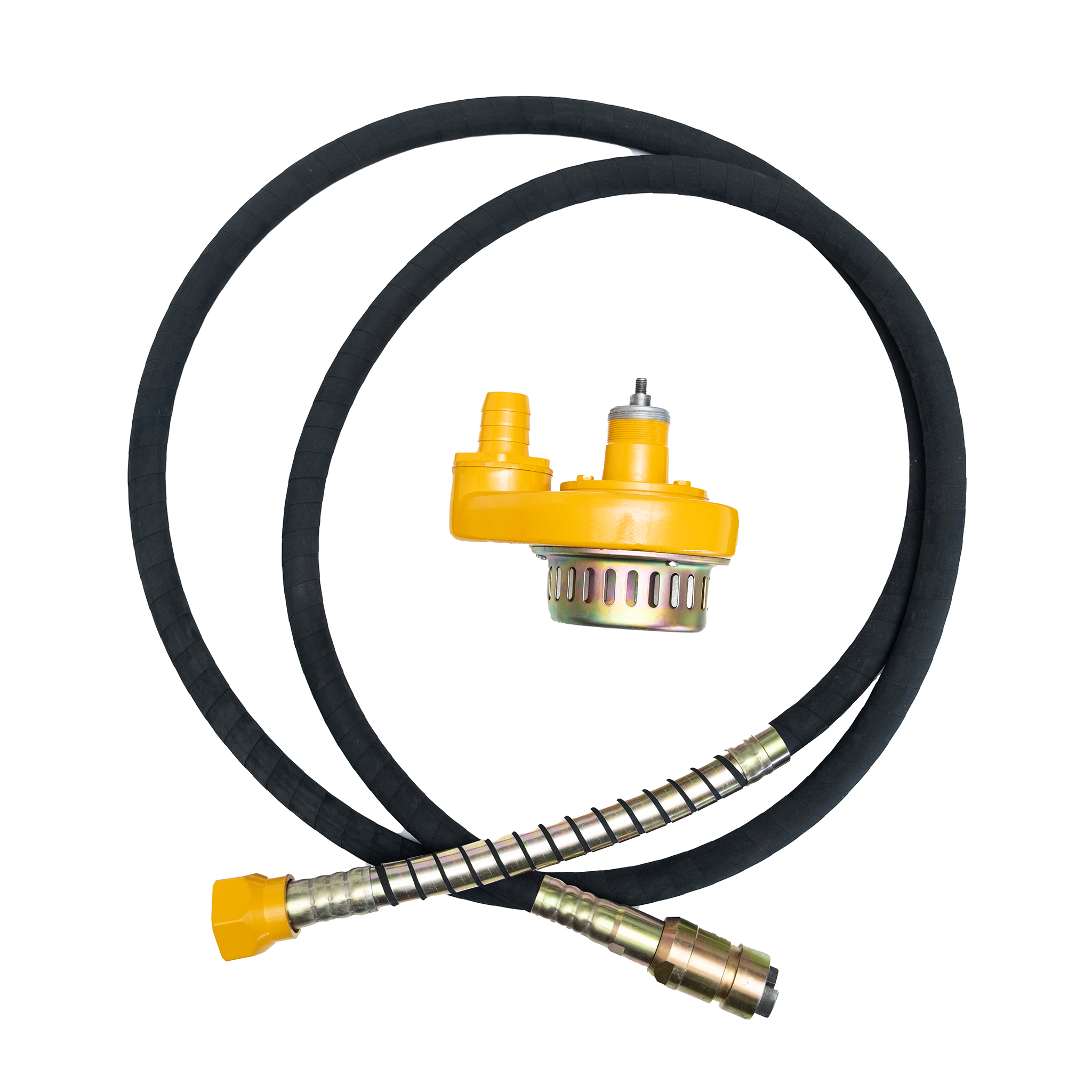
Tech Specs
Drive Source/ Power Source: Drive Unit
Outlet Size: 2″ / 50 mm
Shaft Length: 6 m
Water Displacement (Litres Per Minute): 1 000 L / Minute
Weight: 19 kg
The 2-inch Submersible Pump serves as the agile workhorse for standard site dewatering and trench clearing. Lightweight with a generous 6-meter shaft, this unit strikes a balance between portability and on-site capability. Efficiently displacing up to 1 000 litres per minute, this is the practical choice for contractors who need a reliable, rapid response or general maintenance tasks using standard-sized hosing.
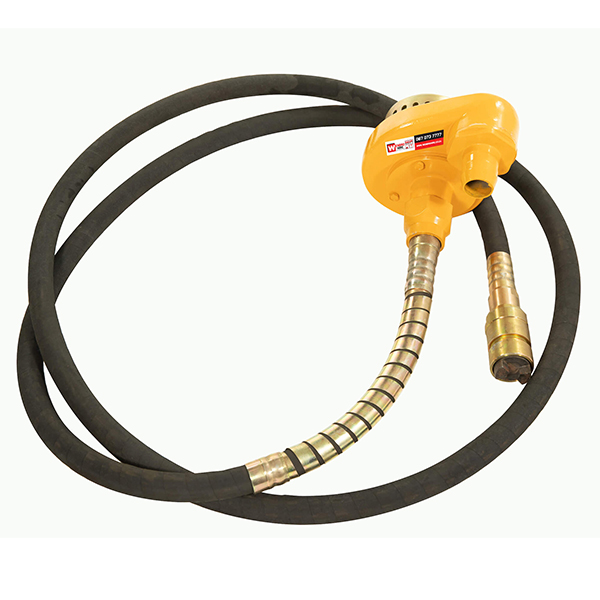
Tech Specs
Drive Source/ Power Source: Drive Unit
Outlet Size: 3″ / 75 mm
Shaft Length: 6 m
Water Displacement (Litres Per Minute): 1 200 L / Minute
Weight: 19.5 kg
For jobs where a higher flow is required from below ground level, choose the larger Pump. With increased discharge capacity, it suits projects where both depth and volume matter. Great for lift pit drainage (draining collected water during construction of multi-story buildings) and large-scale puddle clearance (on sites where water is deep and distant).
The Drive Unit Factor
One of the most critical things to remember is that the pump head and the power source are separate components. Unlike a self-contained surface Pump, the submersible head is lowered into the fluid and must be connected via a flexible shaft to a standalone engine/motor with a coupling, known as the Drive Unit, that remains on dry land. This allows you to swap between power sources depending on the site’s needs without needing an entirely new Pump.
3. Trash Pumps — The Trashman
The Trash Pump is the solution for dirty water containing solids. It features a large, easy-to-open housing that allows you to clear debris manually if needed. Larger impellers and reinforced construction make Trash Pumps suitable for contractors needing a heavy-duty option without constantly cleaning strainers. A great solution for stormwater debris (twigs, leaves, and stones, up to 25% solids) and sewer bypass (like municipal repairs, heavy solids found in wastewater).
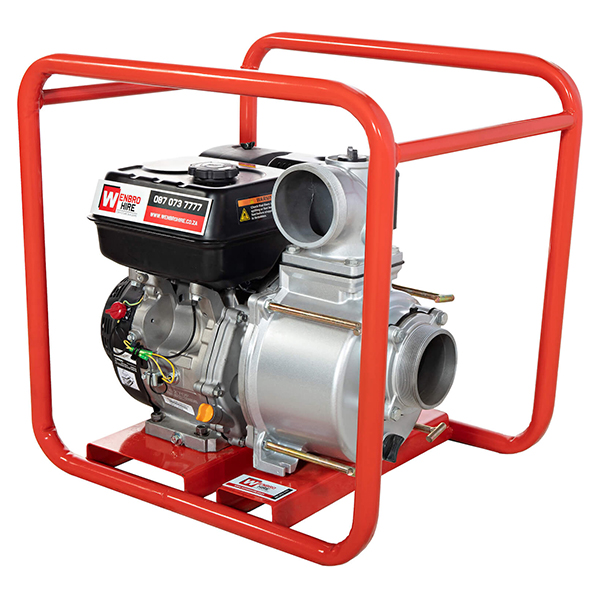
Tech Specs
Engine: 14hp Wenbro Engine
Fuel Type: Petrol
Start Type: Recoil/ Pull Start
Fuel Tank Capacity (Litres): 6 L
Outlet Size: 4″ / 100 mm
Head (Metres): 20 – 25 m
Water Displacement (Litres Per Minute): 1 800 L / Minute
Weight: 48 kg
Sound Output (dB): 96 dB
4. Diaphragm Pumps — The Heavy Hitter
Diaphragm Pumps are problem-solvers for thick, muddy, or debris-laden water. Unlike standard Centrifugal Surface Pumps, they operate via a reciprocating diaphragm mechanism that allows them to pass solids with less risk of blockage. These units are heavier and move lower volumes, but thrive in conditions that would stall standard Water Pumps and even Trash Pumps. Ideally used in mud and sludge (the only tool that won’t clog) or snoring applications (pumping a mix of air and water).
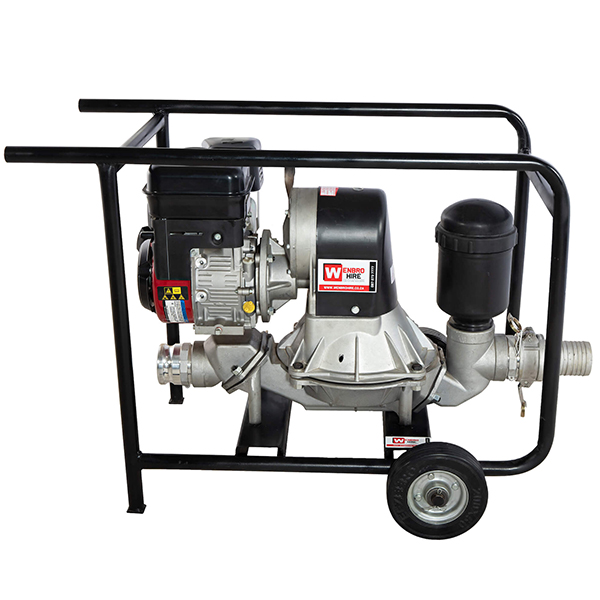
3″ Diaphragm Pump 6hp (Petrol)
Tech Specs
Engine: 6hp Wenbro Engine
Fuel Type: Petrol
Start Type: Recoil/ Pull Start
Fuel Tank Capacity (Litres): 3 L
Outlet Size: 3″ / 75 mm
Head (Metres): 15 m
Water Displacement (Litres Per Minute): 350 L / Minute
Weight: 80 kg
Sound Output (dB): 91 dB
5. Chemical Pumps — The Specialist
Chemical pumps are designed with materials suited to handling more aggressive or corrosive liquids. When transferring chemicals, contaminated water, or fertiliser solutions, compatibility matters. Using a Standard Water Pump in these environments risks corrosion, damage, downtime, and could fail entirely. Ideal for handling saltwater (no rust in marine environments) and industrial fluids (like liquid fertilizers for agricultural use or mildly acidic cleaning solutions).
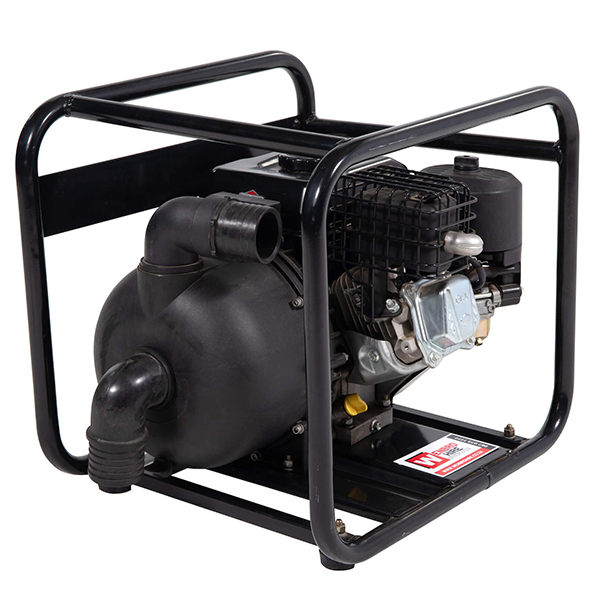
Tech Specs
Engine: 6hp Wenbro Engine
Fuel Type: Petrol
Start Type: Recoil/ Pull Start
Fuel Tank Capacity (Litres): 3 L
Outlet Size: 2″ / 50 mm
Head (Metres): 33 m
Water Displacement (Litres Per Minute): 600 L / Minute
Weight: 28 kg
Sound Output (dB): 91 dB
Matching Pump to Purpose
Choosing the right pump boils down to five practical considerations.
- Liquid Transfer Volume Required
- How much water needs to move, and how quickly?
- Higher litres per minute equals faster clearance, but the added capacity comes with added weight, causing more fatigue and less mobility.
- Head (Total Dynamic Head)
- How far vertically must the water travel?
- A 33m head rating offers strong vertical capability, whereas a 15m head suits shorter discharge runs.
- Nature of the Liquid
- Using the wrong pump can lead to premature wear or complete failure.
- Clean water → Standard Centrifugal or Submersible Pump
- Mildly dirty water with small solids → Submersible Pump
- Dirty water with larger solids → Trash or diaphragm pump
- Chemicals, fertilisers and corrosive liquids → Chemical pump
- Using the wrong pump can lead to premature wear or complete failure.
- Power Source
- Is the site remote? Consider the availability of fuels and electricity.
- Is indoor work involved? Consider exhaust fumes and noise levels.
- Matching fuel type/power source to operational context avoids inconvenience later.
- Access & Depth
- If the water sits deep in an excavation, submersible pumps eliminate suction lift limitations.
In many cases, contractors default to the pump they “always use.” Familiarity is comfortable. But water conditions vary from job to job, and what worked perfectly last time may be inefficient today. Many contractors try to save money by using a standard water pump for every application. Don’t do it. You’ll spend more on repairs and downtime than you would have spent on the correct Pump. If you don’t want to invest in purchasing your own unit, consider hiring instead.
Understanding which pump to use for which situation is the difference between a temporary delay and a missed deadline. Keep your site running even when water refuses to. Taking a few minutes to match the specification to the scenario often saves hours of labour and breakdowns. The right pump is not just about moving water. It is about protecting timelines, fuel costs, and crew efficiency.
If you are planning your next project and want clarity on the best option, speak to the team at Wenbro and make sure you get the right Pump for the job at hand.
Outlet Size Conversion Chart
| Inches | Millimetres |
|---|---|
| 2″ | 50 mm |
| 3″ | 75 mm |
| 4″ | 100 mm |
Technical Specification Summary
| Type | Outlet Size | Power Source | Power | Fuel Capacity | Head | Displacement | Weight |
|---|---|---|---|---|---|---|---|
| 2” Centrifugal Water Pump | 50 mm | Petrol Engine Diesel Engine | 6 hp 4 hp | 3 L 2.5 L | 33 m 26 m | 600 L/Min 700 L/Min | 25.5 kg 39 kg |
| 3” Centrifugal Water Pump | 75 mm | Petrol Engine Diesel Engine | 6 hp 4 hp | 3 L 3.5 L | 33 m 28 m | 900 L/Min 1000 L/Min | 29.5 kg 46 kg |
| 4” Centrifugal Water Pump | 100 mm | Petrol Engine Diesel Engine | 6 hp 10 hp | 3 L 5.5 L | 30 m 31 m | 1200 L/Min 1600 L/Min | 54 kg 64.5 kg |
| 2” Submersible Pump | 50 mm | Drive Unit – Petrol Drive Unit – Diesel Drive Unit – Electric | 6 hp 4 hp 2 kW | 3 L 4 L – | – – – | 1 000 L/Min 1 000 L/Min 1 000 L/Min | 19 kg (pump only) 19 kg (pump only) 19 kg (pump only) |
| 3” Submersible Pump | 75 mm | Drive Unit – Petrol Drive Unit – Diesel Drive Unit – Electric | 6 hp 4 hp 2 kW | 3 L 4 L – | – – – | 1 200 L/Min 1 200 L/Min 1 200 L/Min | 19 kg (pump only) 19 kg (pump only) 19 kg (pump only) |
| 4” Trash Pump | 100 mm | Petrol Engine | 14 hp | 6 L | 25 m | 1 800 L/Min | 48 kg |
| 3” Diaphragm Pump | 75 mm | Petrol Engine | 6 hp | 3 L | 15 m | 350 L/Min | 80 kg |
| 2” Chemical Pump | 50 mm | Petrol Engine | 6 hp | 3 L | 33 m | 600 L/Min | 28 kg |
FAQs
Diesel is generally more fuel-efficient for long-running jobs, while Petrol is often lighter and easier to start.
Yes, we provide the specific housing required to match the pump and application.
Yes! Our standard centrifugal surface pumps require you to add water to the pump chamber before starting. Running them dry will cause the seals to overheat and fail, which is an avoidable and costly mistake.
Head or Total Dynamic Head refers to the maximum vertical height the Pump can lift water from the suction source to a discharge point, measured in meters or feet.
Our units come with a standard 6m shaft length.
Yes, the hoses must be compatible with the specific chemicals being transferred.
No, though they can handle solids, the size depends on the Pump’s intake diameter (usually up to 1/3 of the port size).
Discuss your required transfer volume, site conditions, water depth, discharge distance, and liquid type with our team to ensure the correct match.
Discharge distance depends on the Pump’s head rating and site conditions. As hose length increases, friction can reduce performance, so it is important to factor in both vertical lift and horizontal run when planning your setup.
Products Featured in This Blog
Centrifugal Water Pumpsets (Petrol)
2″ Centrifugal Water Pump 4hp (Diesel)
3″ Centrifugal Water Pump 6hp (Petrol)
4″ Centrifugal Water Pump 6hp (Petrol)
Centrifugal Water Pumpsets (Diesel)
2″ Centrifugal Water Pump 4hp (Diesel)
3″ Centrifugal Water Pump 4hp (Diesel)
4″ Centrifugal Water Pump 4hp (Diesel)
Submersible Pumps
2″ Sumbersible Pump
3″ Sumbersible Pump
Trash Pumpsets
Diaphragm Pumpsets
3″ Diaphragm Pump 6hp (Petrol)
Chemical Pumpsets